Approvals increase as market confidence returns
“Market confidence appears to be returning to the home building market, with an increase in residential building approvals in the month of July,” stated HIA Economist, Maurice Tapang.
The Australian Bureau of Statistics today released its monthly building approvals data for July 2024 for detached houses and multi-units covering all states and territories.
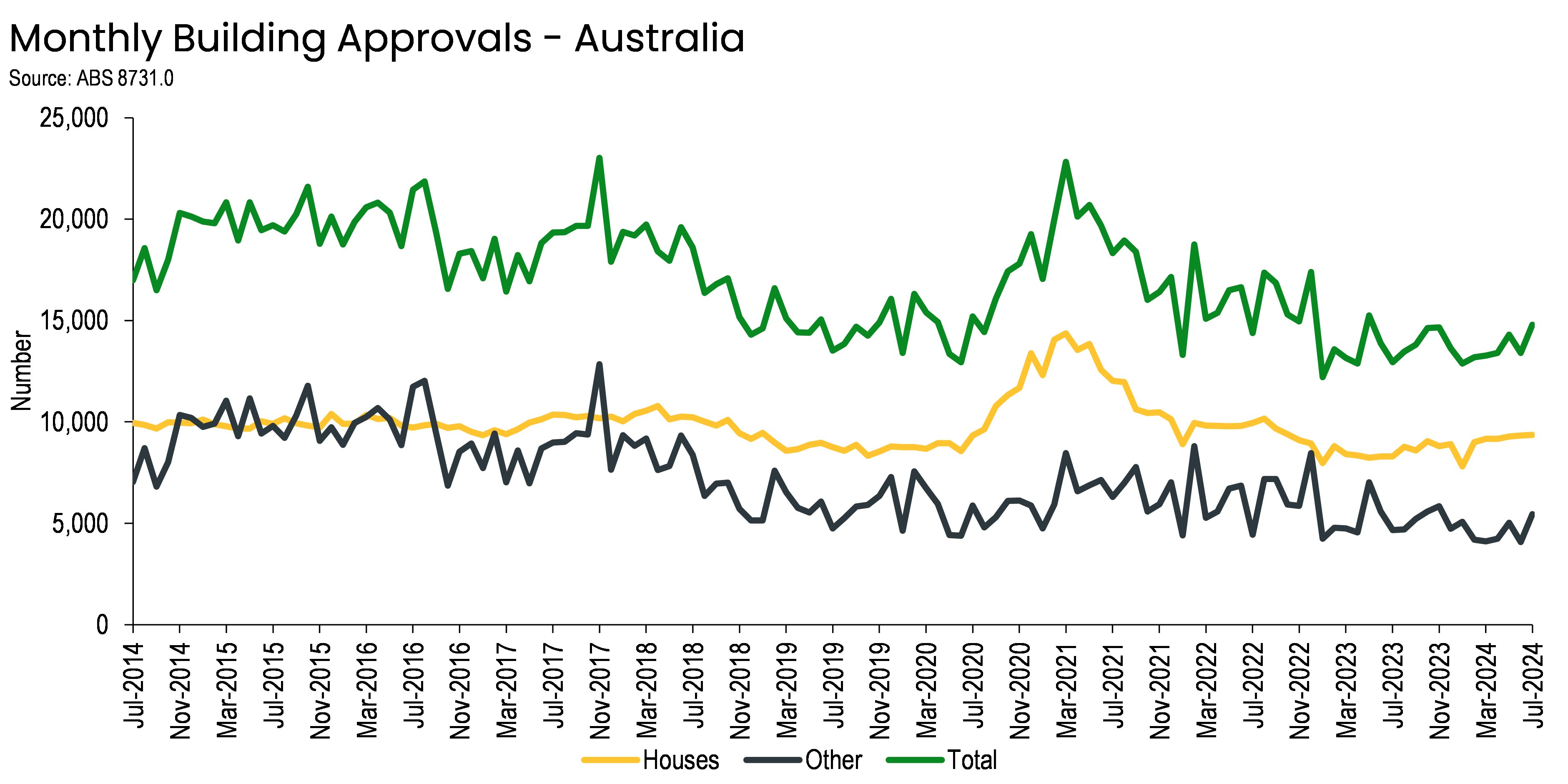
“Residential building approvals rose by 10.4 per cent in the month of July 2024, with a 0.3 per cent rise in approvals for detached houses and a 33.7 per cent rise in multi-unit approvals,” added Mr Tapang.
“Nationally, there were 9,350 detached homes approved for construction in July 2024 and 5,440 multi-unit approvals.
“The small increase in detached home approvals is being driven by what appears to be sustained improvements in Western Australia, Queensland and South Australia, while New South Wales and Victoria remain more constrained.
“The strong improvement in the number of multi-unit approvals comes off the weakest month for multi-units in 12 years.
“House approvals over the three months to July 2024 were 2.3 per cent higher compared to the previous three-month period, to be 12.6 per cent higher compared to the same time in the previous year.
“Across the capital cities, house approvals in the three months to July rose by 19.8 per cent in Perth compared to the previous three-month period, with Adelaide recording an increase of 13.7 per cent and Brisbane an increase of 10.6 per cent.
“The two largest capital cities recorded more modest increases in house approvals, with Sydney up by 2.8 per cent compared to the previous three-month period and Melbourne up by 2.0 per cent.
“The uplift in home building approvals in those markets outside of Sydney and Melbourne has been driven by strong economic conditions and the relatively lower cost of delivering a new home.
“It has been almost ten months since the last increase in the cash rate. Stable interest rate settings have provided the certainty needed to see a rise in home building confidence.
“Materials price growth and build times for homes have stabilised and returned to normal pre-pandemic levels, which provides certainty with the cost to build.
“Unemployment remains very low, and there are now more people employed in the economy than there were prior to the pandemic.
“There is strong demand for homes and a low level of supply, as evidenced by low rental vacancy rates particularly outside of Australia’s southeastern capitals.
“Policymakers that ease the tax and regulatory burdens on new homes will also help in lowering the cost of delivering a completed home to market,” concluded Mr Tapang.
House approvals over the three months to July 2024 increased by 57.6 per cent in Western Australia compared to the same time in the previous year. This was followed by Queensland (+22.1 per cent), Victoria (+8.8 per cent) and South Australia (+4.4 per cent). The other jurisdictions recorded a decline over the same period, led by Tasmania (-19.3 per cent), the Australian Capital Territory (-12.4 per cent), the Northern Territory (-8.2 per cent) and New South Wales (-4.7 per cent).