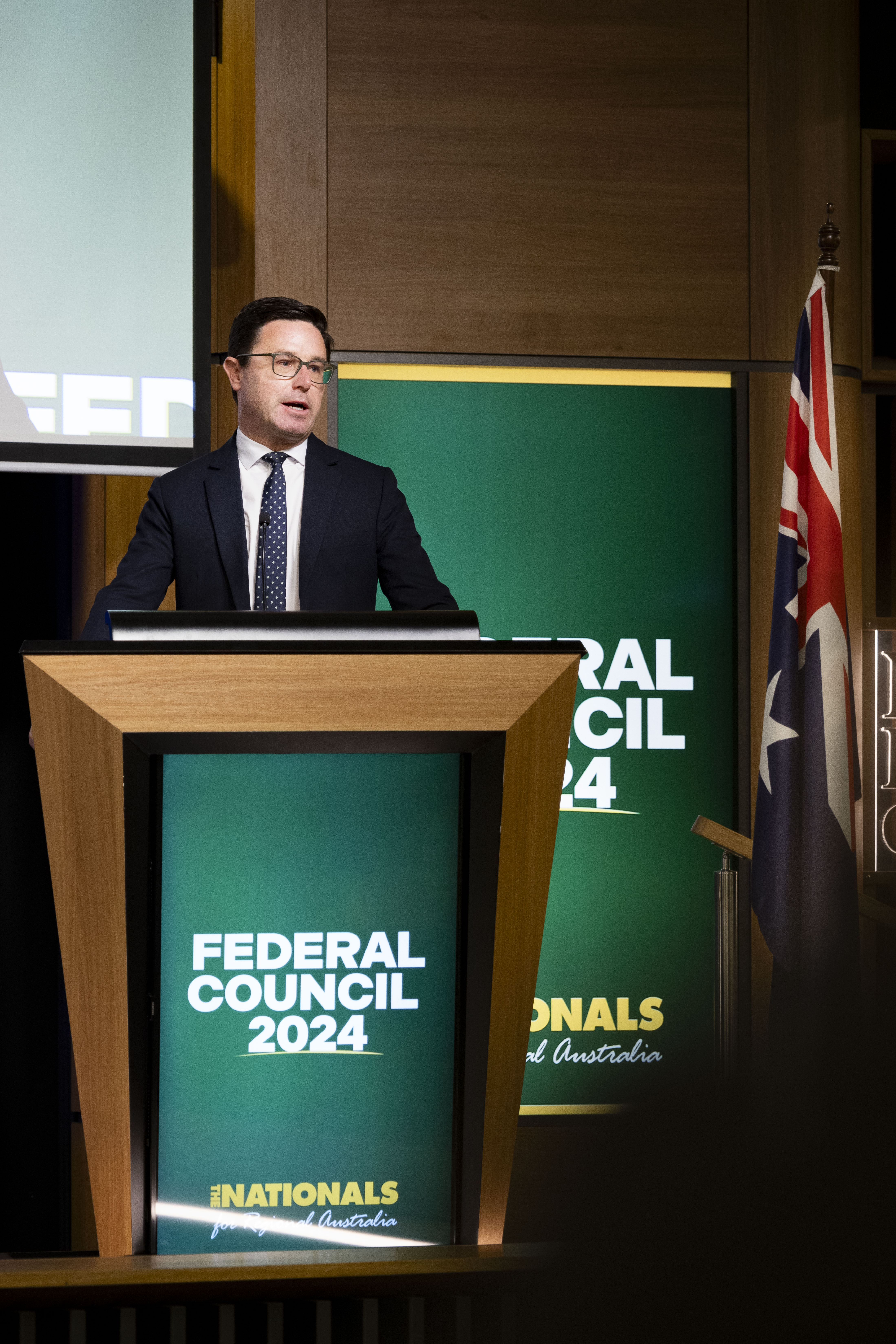
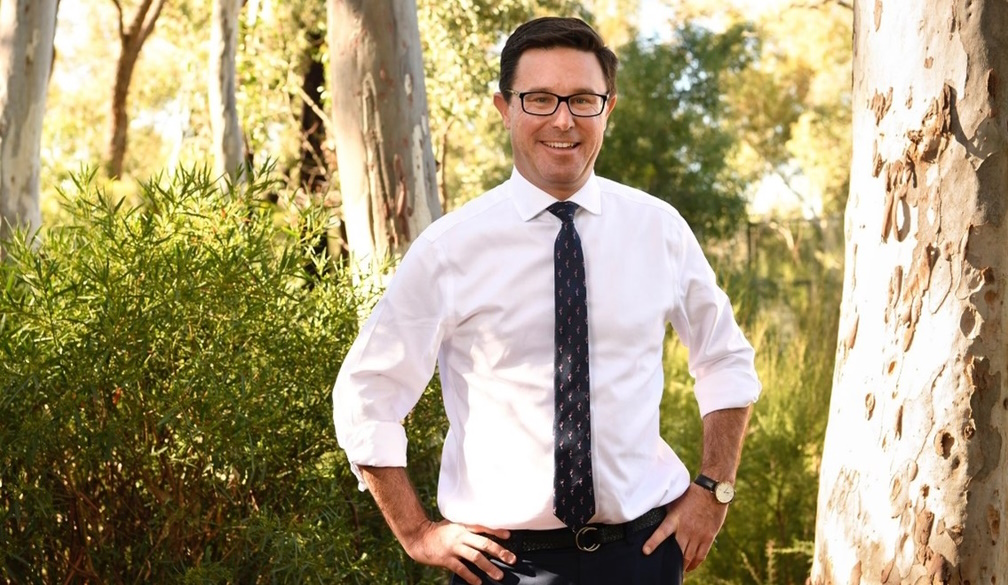
Leader of The Nationals David Littleproud - Federal Council address
Well, thanks, Pez, (Senator Perin Davey), and welcome to The National Press Club in what is a less hostile environment than the last time I was here, to you, President Kay, and to all the executives, thank you to my federal team. It's great to have you here this weekend, but can I single out one person who will not be back again for our next Council? And that's Mark Coulton, the member for Parkes. Mark has indicated that he'll be retiring and can I just make my public pledge of the support and the friendship that Mark has given me and Amelia and the way that he has conducted himself in this Parliament.
It has been with absolute integrity. And there is not a person in that Parliament that does not respect Mark Coulton. All that he has done, all that he has fought for, for the people of Parkes over the 17 years of service and leadership, he has provided here in this Parliament and then prior as a Mayor of local Council, and to his wife Robyn, who really gave us a two for one job. But Robyn has been steadfast in the support and love of Mark and raising an amazing family that's contributing to our great country. To you, Mark, the proudest thing is not to have served with you, but to call you a mate. So thank you, Mark and Robyn, for all that you've done.
And I welcome Jamie Chaffey and his beautiful wife Judy, who will join The National Party family, hopefully living up to those big shoes that Mark and Robyn have left. And welcome and congratulations to our state team, to (Peter) Walshy. It's great to see my good mate, Victorian leader Walshy, to Dugald (Saunders) and to Shane (Love), all the way over from Western Australia. Thank you for coming.
But to you, the members, thank you. This is your Council. This is about you. It's about the primacy of our membership, delivering and directing your party group in a direction that fits the values and principles, not just all of our party, but the communities that we represent. Yours is truly a pure one. You aren't here for financial reward, but because of your belief in your community and your country.
And so we take the guidance that we get at conferences like this very seriously. And I'm proud to say that the party room that I have led is one that has respected our membership more than ever before. Never before have you seen a party dictate the policy direction of the public debates in this country over the last two and a half years than what you have seen from The National Party federal team. I'm proud of their efforts and I'm proud of the way that we have directed public debate in this country over the last two and a half years.
We started it. We started it when we made the principal position on the 28 November 2022, when only 32 per cent of Australians supported the position that our party room got to in opposing a Voice. It wasn't one predicated on anything other than us repeating the mistakes of the past, putting another layer of bureaucracy going down, an ATSIC mark 2 model that wasn't going to change the lives of those most marginalised in the rural and remote areas that we represented. We didn't want to repeat the mistakes of the past. And so we made it clear that we were going to stand by our values and principles, even when those, even in the Fourth Estate, questioned, ‘how would it feel to be on the wrong side of history?’
Well, your party room and you made history and changed history. Because we were prepared to stand up and stand for what we believed in and the people we represent. We should be proud of that and what we did after it. We were the only ones to come back to this Parliament and to move legislation in the House of Representatives. Peter Dutton and I moved policies to actually start a full and open transparent audit of all Indigenous spending in this country to ensure that it goes to the outcomes that we expect it to go to.
And we called for a Royal Commission into child sexual abuse in central Australia that were real, definitive actions. That was real strong leadership that this country was asking after the Albanese Government divided our nation with a $450 million Referendum. We didn't stop. We decided to take up that cause and to make sure that we changed those lives for the better. And I'm proud that we stood there and did that because it validated the position we took in not supporting the Referendum, but validated the position that we are here to ensure those, particularly in rural and remote Australia, those Indigenous Australians that need the help that we were going to deliver it to them.
And that's the real leadership and strength of leadership that we've been prepared to provide. We're also prepared to lead on nuclear energy. We've long held that view. But this is the first time, the first time in our nation's history, that we now have a Coalition policy that will transition some of our coal fired power stations across the nuclear powers. We will need gas.
The only way to bring down the cost-of-living pressures in electricity that families and businesses are feeling now is to bring on more gas and to bring it on quicker. And we can bring much of that on under 12 months. That's real action of increasing supply and dropping prices. We're not against renewables, but we have had now a saturation point across regional Australia, where the low hanging fruit has been achieved, where many of these renewable projects are underneath the existing transmission lines.
And while we didn't condemn those, we do now that we now have to expand beyond those transmission lines, adding another 28,000 kilometres of transmission lines, taking up our prime agricultural land and tearing up your food security and pushing up your food prices, because we are laying these kilometres of transmission lines, the solar panels and wind turbines across our landscape, but we are also destroying the very thing that we're there to protect, the actual natural environment. Why wouldn't we use an energy mix, not put all our energy eggs in one basket, to put the nuclear power plants where existing coal-fired power stations are? So we don't need those transmission lines to have an energy grid that can support manufacturing, not have to continue to subsidise it, to fix the fundamentals of manufacturing by giving affordable, reliable power and proper industrial relations policy. That's how we work as a government, to fix the fundamentals, to deliver not only cheap energy, but keep manufacturing going. And it's been the National Federal Party team that listened to you and has delivered that as a policy that we will deliver at the next federal election.
We are proud to have led that and we are the first ones to achieve it. Can I also say we took the courageous position on vaping in protecting children. One of the biggest scourges across society is seeing children succumb to vaping. We have to look at what's worked in the past, look to history to see what has achieved. And when you look at what we did with tobacco and cigarettes, we actually saw, when we regulated it through licenced retailers, the product and the packaging and the ingredients. In essence, we saw an 80 per cent reduction in juvenile use of cigarettes.
So why wouldn't we go down a path that history has shown us, has worked before, where prohibition has failed? Why wouldn't we use a common sense approach? And why wouldn't we give back to the Australian taxpayer, the over $3 billion worth of excise that currently goes to organised crime, rather than into supporting our health and our law enforcement? That's the common sense solution The Nationals had the courage to stand up for and to lead, and now is policy that we will take to the next election.
We've also had the courage to stand up to the supermarkets. Many have come to our party room, long before myself, that have advocated for stronger competition policy in the supermarket sector. Ron Boswell, the great Queenslander, championed his 17 years in the Senate to this cause. Your Federal National Party team is going to deliver a competition policy that's not just about divestiture.
Divestiture is not about simply trying to walk in and break up the supermarkets tomorrow. It is a deterrent. It is about changing the culture of these organizations, of how they deal with the farmer and how they deal with you as consumers. And divestiture is that big stick at the end. And let me say, we already have divestiture powers in this country. We in fact passed them in 2019.
And Anthony Albanese supported those divestiture powers there. But for some reason, when there are Australians tonight that will not have dinner, they will not have dinner because they cannot afford to put the food on their plates and the plates of their children, we have a Prime Minister who was once prepared to stand up to the big CEOs of the energy companies, but today is not prepared to stand up to the big CEOs of the supermarkets.
You have to ask why? And our policy is one that formulates all the way through using the existing codes of conduct, but also is implementing for the first time, a Supermarket Commissioner that can arbitrate quickly, one that hasn't been there before, that actually allows farmers to come forward in a confidential manner without the supermarkets knowing and without the fear of retribution, that they can make their claim against the supermarkets.
And the Commissioner can either conciliate with that farmer back to the supermarket if they feel comfortable, but if they don't, they can actually escalate that to the ACCC. And what we're doing is giving the ACCC bigger powers, not just divestiture, but infringement notices. These are the speeding tickets that will change the culture of these big companies instead of what this government is proposing, $187,800 is the maximum infringement notice. They can pull that out of a till in Sydney, Melbourne or Brisbane to pay it as a cost of doing business.
Ours is a $2 million flat, simple, straight infringement notice that the ACCC can give to these big supermarkets if they mistreat the farmer or they mistreat you as consumer. That's about changing culture. If it's more egregious, then obviously the courts will then determine, firstly whether it is $10 million or 10 per cent of the turnover, which we agree with the Government. But in the most egregious case, there should be something that is far more stringent, something that sends a very strong message that we are watching, and that is divestiture powers. Those divestiture powers, we are putting in safeguards to ensure that we protect Australian jobs and we increase competition.
That's common sense. And for the first time, our Coalition partners have taken our hand because of the relentless campaign that our federal team have been able to articulate and change. That's not the silver bullet in bringing down food costs, but is one of them one of the sweeter measures that will continue to help families, know that there is fairness from the farm gate to your plate. That's all Australians want, to know that if there's a drop at the price at the farm gate, there's a commensurate drop at the checkout.
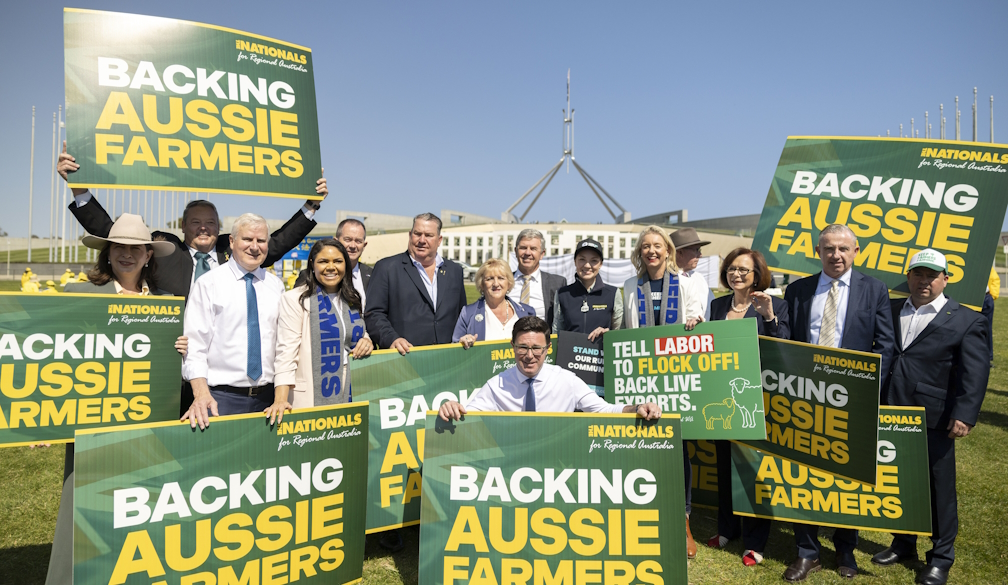
And if it goes up at the farm gate, you should see a commensurate rise at the checkout. At the moment, we are not seeing it. And so this is sensible competition policy that your federal team has achieved, all from Opposition in two and a half years. And once we are elected, we'll be implementing it and we need to be able to say to the Australian people that we have a vision in not only those big issues that are affecting the cost-of-living, but also those in rural Australia. And the first action that I'll take as the next Deputy Prime Minister and Agricultural Minister is to reinstate the life sheep industry.
My first international trip will be to Kuwait, Qatar, Saudi Arabia and Jordan to make it clear to them that they can trust us, that their food security is as important to us as it is to them, that we can continue to do this.
We can continue to lead the world. Anthony Albanese is prepared to cut and run. And when he has cut and run, there will be the perverse and horrific death of millions of sheep from countries like Ethiopia, Sudan, South Africa, all because they don't live up to our standards. We measure the success of a shipment of sheep, not on mortality, but on animal welfare. We are the only country in the world that does that.
Those countries simply put as many sheep as they possibly can on a boat and get paid for what's left at the other end. Animals Australia and RSPCA are morally bankrupt. That they would sit there and prefer to see those actions from those countries take place rather than the Western Australian industry continue on with world-leading animal welfare standards. That is hypocritical and it's morally bankrupt.
And I can give you this commitment. Do not underestimate our determination to reinstate this industry. It will happen and there will be no contagion on the cattle industry. There'll be no cutting and running from the cattle industry.
And we do need to settle the live export case. The case that has been predicated by the fact that last time Labor was in the in government, they, overnight, shut down the live cattle export industry in Indonesia. They destroyed lives. A court found that and it should be now determined that that compensation should be paid so those people can get on with their lives. We'll make that commitment that we're going to get on with the job and get that sorted. This hurt, this pain, needs to end, and we have a responsibility to win the next election to do that.
We give you that commitment and we do.
We're not going to take another 450 gigalitres out of the Murray-Darling, not take that away from the consumptive pool, pushing up your food prices. We're not going to charge you a biosecurity tax to bring in foreign competitors’ product into this country that you're going to pay their cost for. We're not going to make you put out your emissions profile on your farm so you can report them to your banks, costing the economy $3.2 billion. But we are going to make it easier for particularly those people living in regional Australia, going to the heart, not just the cost-of-living and driving down their energy bills and their food bills, with a sensible energy policy and one that escalates gas in the short-term to bring down prices, but in the long-term given us greater reliability with a greater energy in nuclear.
But we're also going to look at those cost-of-living pressures that families in regional Australia are feeling every day. Those young families can't go back to work at the moment because they can't find a childcare place. When I first became the Leader of The Nationals, I took a pragmatic step. I didn't want to be a harpy in Opposition. I made a conscious decision to go to the Government's Jobs and Skills Summit, to make sure that regional Australia had a voice.
And at that Summit, they announced $4.7 billion worth of subsidies for childcare. This is over $20,000 of subsidies for families on $300,000 to $500,000. And I made the plea to the government that some of that $4.7 billion should be put towards increasing the number of places and at childcare centres in rural and remote Australia, so that families could fight the cost-of-living pressure by at least going back to work in our communities. They can't. And so we'll be focusing on increasing childcare places in regional areas to ensure young families know that they'll have the support and the ability to go back to work and pay for Albanese's cost-of-living crisis.
That's the common sense solutions that we want to say to young Australians out there, to have their families and know that they can go back to work and contribute to regional Australia.
We want to make sure that our regional health services are up to scratch, investing in what's the most important asset, the human capital. The professionals that we need in regional Australia to provide the services we need only come from us training them in the regions. So it's important that we get that supply back up, that we don't listen to the AMA (Australian Medical Association) and the model that they've taken that's basically destroyed regional health. The AMA is responsible for basically the destruction of regional health.
Their militancy has forgotten about those that live in regional and rural Australia. It's now time to increase supply of our doctors, our nurses and our allied health. Not to listen to an AMA that probably, I represent more doctors in the electorate of Maranoa than they represent.
So, candidly, this is about us drawing a line in the sand, because if we don't draw a line in the sand and we don't articulate the vision of how we're going to bring down the cost-of-living and get out of your life, then you'll have three more years of Anthony Albanese.
If we don't win in the seat of Calare with Sam Farraway, then you get three more years of Anthony Albanese. If we don't win with the great Mia Davies in Bullwinkel, you get three more years of Anthony Albanese. And I can tell you, if we win with Andrew Lethlean in Bendigo, we have dead set got rid of Anthony Albanese.
So this comes down to how much we want it? How much do we want to win the next federal election? How much do we want to make sure this is Anthony Albanese’s only three years, because regional Australia cannot afford another three more. Three more years of Anthony Albanese, this country cannot afford another three more years of Anthony Albanese. Australians need to ask themselves, do they feel safer and do they feel better off after two and a half years of Anthony Albanese? The answer is, they don't. But let me give you this commitment. A Dutton Littleproud Government is going to look every Australian in the eye.
We're going to tell you how it is, how we're going to fix it, and we're going to get on with the job of doing it. And above all, we're going to bring some common sense to Canberra.